
Dying pines: bark beetles after drought
When a loblolly or shortleaf pine dies in a Faulkner County yard after a dry year, bark beetles are usually involved. The Arkansas Department of Agriculture's Forestry Division says Ips pine engraver beetles periodically kill pines, typically after drought, and that dying red pines are usually Ips-infested. The U of A's forestry page adds that in most years Ips are more common in Arkansas than the southern pine beetle (both checked Nov 10, 2026).
The southern pine beetle, the one with the worst reputation, has been quiet here. The Forestry Division says that in Arkansas it "has not been a problem since the mid-1990s" (checked Nov 10, 2026), and the U.S. Forest Service's 2025 report for Arkansas counted zero southern pine beetles in its traps for the second year in a row.
Drought is what opens the door. The U of A's fact sheet on pine bark beetles says they "attack pine trees that have been stressed, usually from drought or overcrowding." The state's 2023 forest health report called the 2022 drought one of the most substantial factors in pine decline, and after a 2015 drought, Ips hit weakened loblolly pines on about 21,000 acres, worst in Sevier, Howard and Polk counties, according to the state's 2016 report. Central Arkansas has been in drought since 2025, reaching extreme to exceptional levels in 2026, according to the weather service and the U of A. Extension forester Jon Barry notes that trees damaged by drought "will continue to be susceptible to bark beetles for a few years."
Signs of beetles in a pine
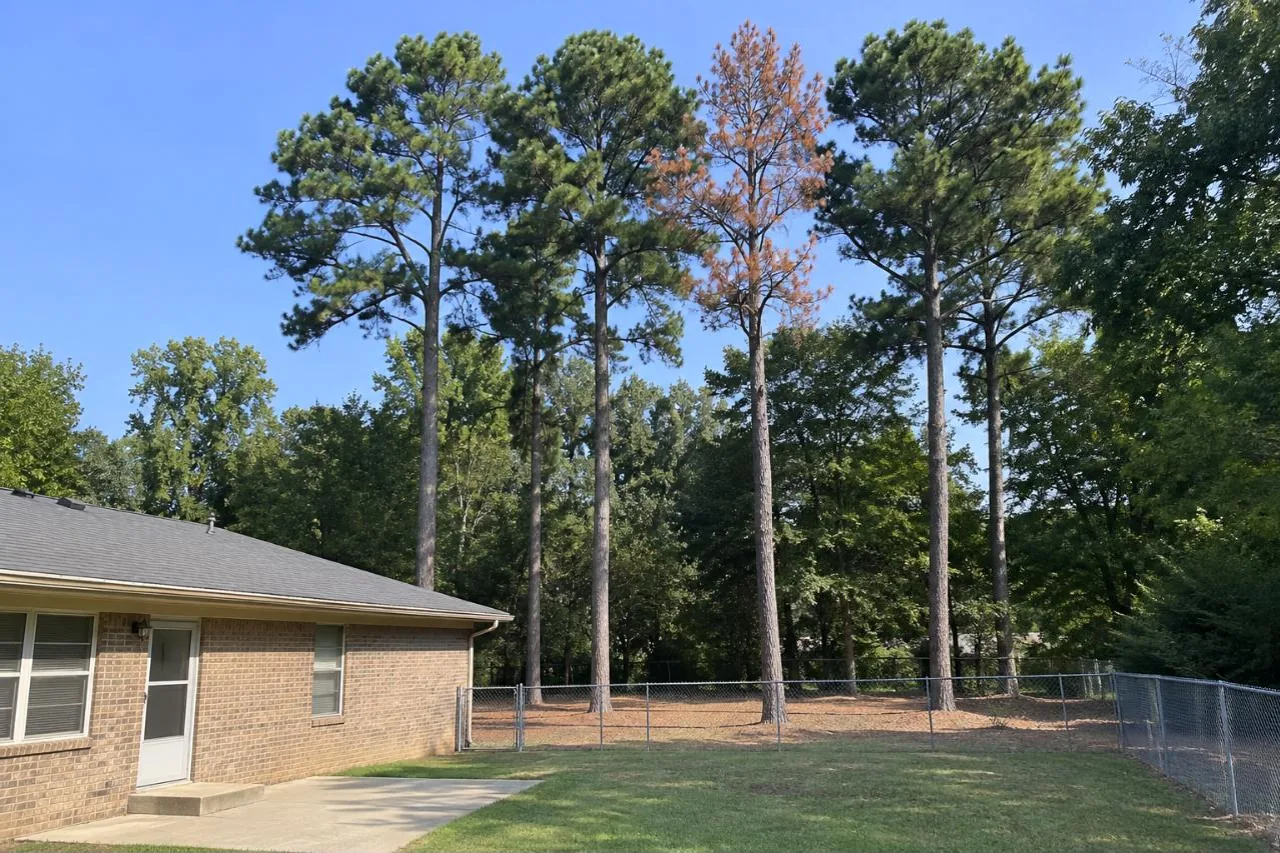
- A fading crown. The U of A says the needles of an attacked pine fade "to yellow and then quickly to red," like the tree in the photo above.
- Pitch tubes. Small blobs of resin on the bark where beetles bored in. The U of A's forestry page describes Ips pitch tubes as dime-sized and reddish-brown; its fact sheet notes white or cream tubes from southern pine beetle and Ips, and reddish ones from the black turpentine beetle.
- Boring dust. Reddish-brown dust in the bark crevices, or fine dust collecting around the base of the trunk.
- Loose bark. Mississippi State University Extension says pines with red tops and loose bark should be removed promptly as hazards.
Why a red pine shouldn't wait
Mississippi State Extension says that once beetles are boring into the inner bark, it's too late to save the tree, and that a generation of beetles takes about four weeks in warm months. The U of A's advice for Ips is to remove infested trees promptly and use or destroy them, including the bark and debris. For salvage, its fact sheet says Ips work is best done "in the late fall or winter when the insects are not active."
Two practical points follow. A dead pine near the house is a falling hazard no matter what killed it. And the pines you're keeping need protecting during the job: Mississippi State says soil packed down or rutted over the roots during tree work raises the risk of beetle attack.
Dying oaks
Oaks fail differently. The U of A's plant health clinic says the hypoxylon canker fungus is "unable to attack and kill healthy trees" but takes over oaks stressed by drought, heat, insects, crowding, or saturated or compacted soil. The signs come in order: yellowing leaves, a thinning crown and dead branches first, then bark loosening and falling off near the base to show a powdery mat that turns dark brown to black, then silver-gray. Once the canker circles the trunk, the clinic says, trees turn brown and die "apparently overnight." A U of A reference answer puts it bluntly: "Once bark begins to fall, you can't stop it."
There's no cure. The dying oak guide covers hypoxylon, post oak decline and water oaks in detail.
Other trees in trouble
- Ash. Emerald ash borer is confirmed in 44 of Arkansas's 75 counties, including Pulaski next door, per the Forest Service's 2025 report (checked Nov 10, 2026). The Forestry Division says "we will eventually see it infesting ash in every Arkansas county," and that single trees can be protected with an insecticide treatment.
- Oaks with holes. The carpenterworm attacks mainly oaks, and the U of A lists "serious impacts on yard trees." Look for brown pupal skins sticking out of holes in the bark.
- Water oak. NC State Extension says water oak "may only live 30 to 50 years," so an old one may be near the end of its life.
- Bradford pear. The U of A says it has "a poor crown structure and is prone to breakup," and that the trees "are bound to fail you in a strong storm."
- Sassafras. Laurel wilt, carried by the redbay ambrosia beetle, is moving through Arkansas and threatens sassafras, according to the Forestry Division.
Leaning trees
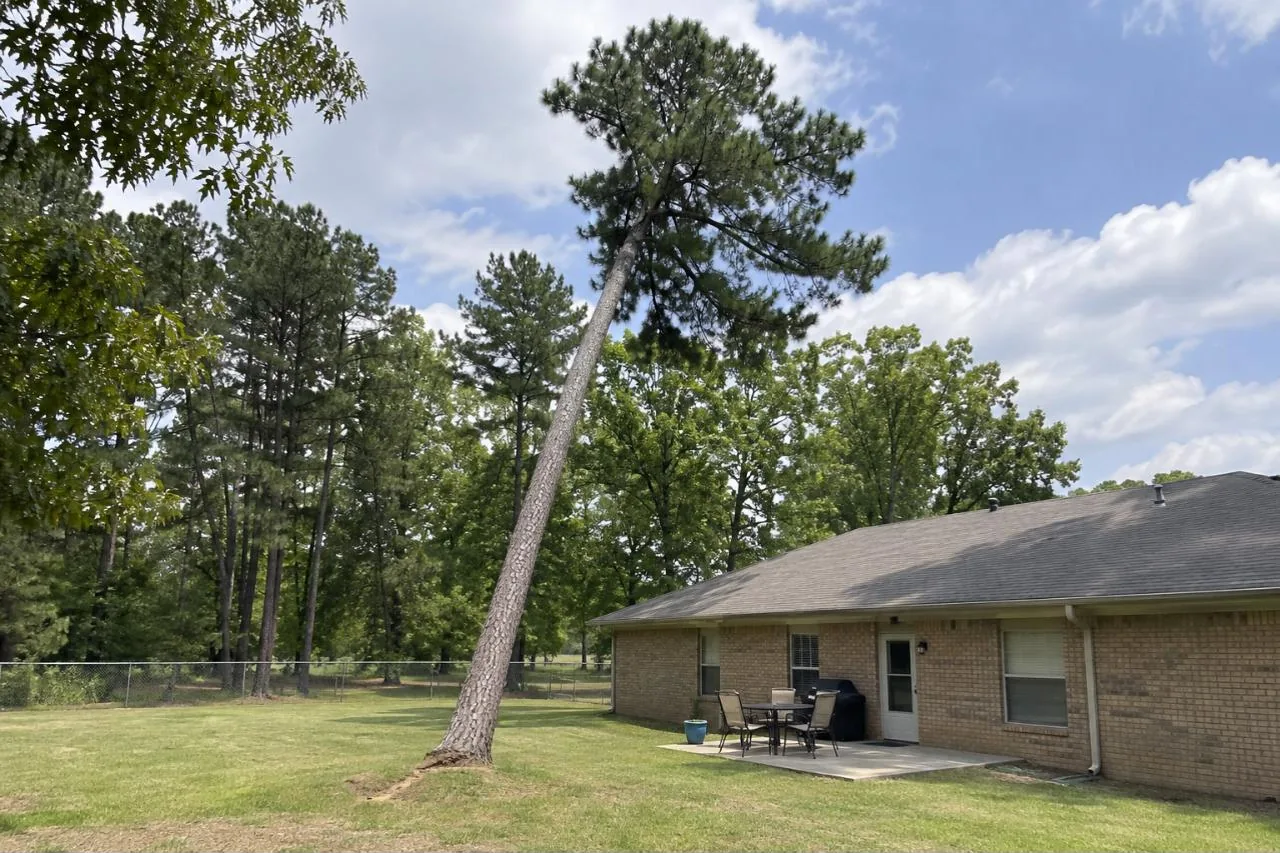
The lean to worry about most is a new one: a tree that was straight last year, or one that tipped further after a storm or a week of rain. Soil cracked or raised at the base on the side away from the lean suggests the roots are moving. If a leaning tree could reach the house, a shop, the driveway or a power line, keep people out of its path and get it looked at soon.
When you call, say which way it leans, roughly how tall it is, what it would hit, and whether the lean changed recently. Photos from a few angles help.
Roots and soil around here
The U of A's Jon Barry notes that about 80 percent of a tree's roots grow in the top 18 inches of soil. USDA's soil descriptions for the Arkansas Valley and Ozark foothills show why roots often can't go much deeper here: hillside soils such as Mountainburg reach sandstone at 12 to 20 inches, Linker at 20 to 40 inches, and silty flats such as Taft and Guthrie have a dense fragipan at about 20 to 36 inches, with some areas ponding in winter and spring. Which soil is under your lot isn't something this site checked, but it's one reason to protect the root zone of any tree you want to keep: no trenching, no piled fill, and no heavy trucks parked over it.
NC State Extension also notes that sweetgum has a shallow root system.
When a dead tree stands near the house
The U of A's fact sheet on hypoxylon canker says canker diseases can "result in wind breakage," and that removal may become necessary "if structural integrity becomes questionable, especially if the tree poses a threat to structures or people." That advice applies just as well to a beetle-killed pine. Falling trees do kill people in this part of Arkansas: on June 25, 2023, NWS Storm Data recorded that in Carlisle, in neighboring Lonoke County, "a large tree fell on a house, causing two direct fatalities and one injury."
If the dead tree is your neighbor's, talk to them early. The Insurance Information Institute said in 2010 that when a neighbor's tree damages your house, your insurer may go after the neighbor's insurer, especially if the tree was in poor health or not maintained.
What removal costs
Thumbtack's 2026 tree removal guide puts the national average for cutting down one tree at $450 to $1,450, with its size tiers set by trunk width and canopy spread (checked Nov 10, 2026). A dead tree over a roof may need more rigging. The contractor's written price is what counts. See what tree work costs.
Questions about dead and leaning trees
My pine turned brown in a few weeks. Could it come back?
Not if beetles killed it. Mississippi State Extension says once beetles are in the inner bark it's too late, and the U of A advises prompt removal of infested pines.
Should I spray my other pines?
The extension sources on this page focus on prevention through tree health: watering in drought, avoiding root damage, and removing infested trees quickly, bark and all. Ask the contractor about the trees around the dead one.
Is a dead tree an emergency?
If it could hit the house, a car or a place where people walk, treat it as urgent. There's no reliable figure for how long a dead tree stands before limbs or the trunk fail, so don't count on time.
The tree leans toward my neighbor's house. Whose problem is it?
Talk it over with your neighbor and photograph the tree. If a tree in poor health falls on their house, the Insurance Information Institute said in 2010 that their insurer may try to recover the cost from yours, especially if the tree wasn't maintained.
A request sent from this site goes to one independent contractor who works in Conway and Faulkner County. The site itself doesn't inspect or cut trees.
Sources
- Arkansas Department of Agriculture, Forestry Division, Forest Health (checked Nov 10, 2026); Forest Health Highlights 2023; Forest Health Highlights 2016.
- USDA Forest Service, Arkansas Forest Health Highlights 2025. Checked Nov 10, 2026.
- U of A Division of Agriculture, FSA5034, Pine Bark Beetles in Arkansas; Common Insect Problems (checked Nov 10, 2026); Plant Health Clinic Newsletter, May 29, 2018; reference desk, canker; FSA7557; Bradford pear; drought news, June 29, 2026.
- Jon Barry, U of A, Receding Drought Leaves Deadly Touch Among Arkansas Trees.
- Mississippi State University Extension, Bark Beetles in Urban Pines.
- NWS Little Rock, January 2026 summary and Storm Data, June 2023.
- NC State Extension Plant Toolbox: water oak, sweetgum. USDA soil series: Mountainburg, Linker, Taft, Guthrie. Checked Nov 10, 2026.
- Insurance Information Institute, insurance for fallen trees, July 22, 2010.
- Thumbtack, Tree Removal Cost Guide 2026, updated March 24, 2026. Checked Nov 10, 2026.