Why so many oaks are dying now
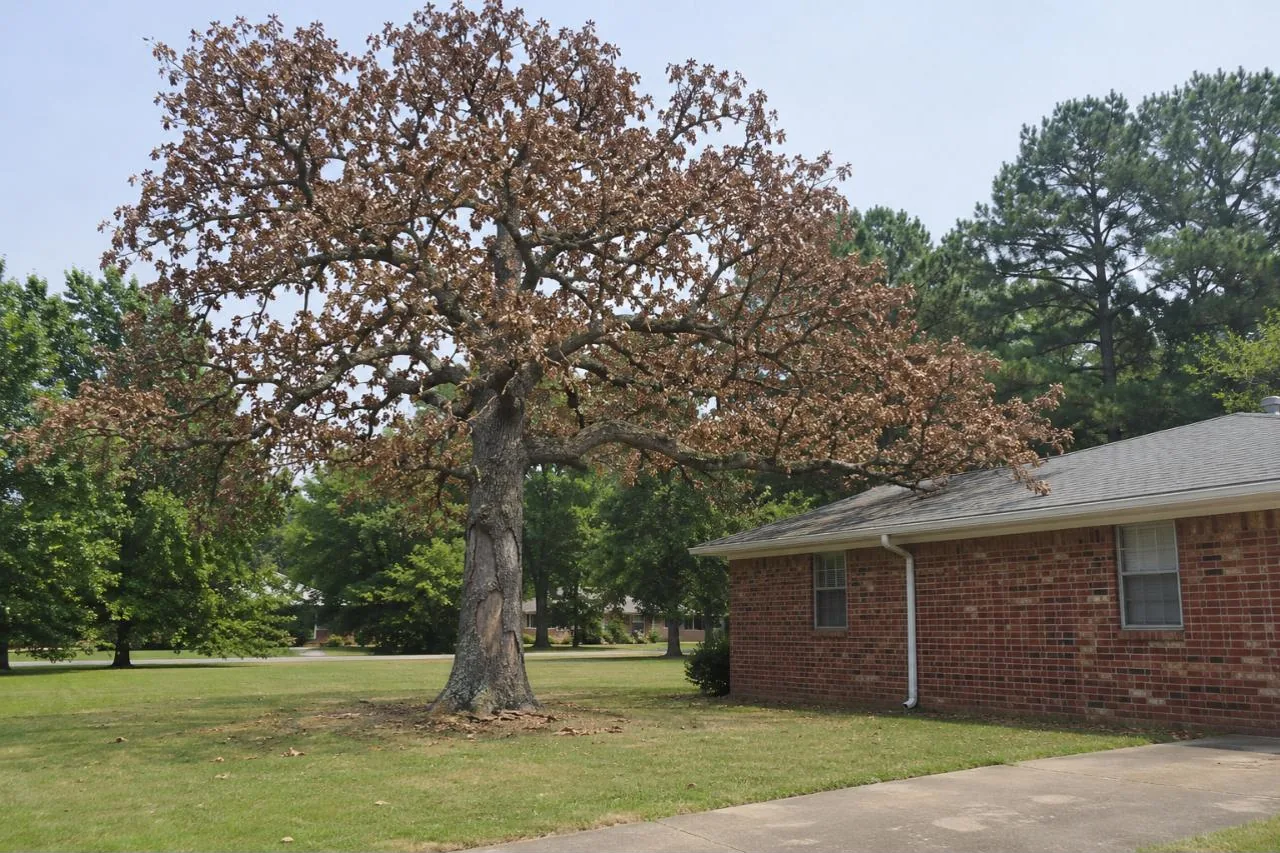
The drought is the root cause. In late January 2026, the weather service's Little Rock office showed extreme to exceptional drought, the two worst categories, over parts of central Arkansas. On June 29, 2026, the University of Arkansas Division of Agriculture reported that drought had been affecting the state for more than a year, that the central region was in extreme or exceptional drought, and that the state's drought severity index had climbed from 184 at the start of 2026 to a peak of 372 in April.
The same report singled out post oaks. "Seemingly healthy trees will just randomly die overnight," extension forestry educator Jaret Rushing said. By August 20, he said, "the stress that the trees have been under for the past 12 months with the drought has really started to show," with trees dropping leaves early. Faulkner County spent August 13 to November 3, 2026 under a burn ban (checked Nov 10, 2026).
Arkansas has been here before. During the 2011 drought, a U of A horticulturist wrote that hypoxylon canker "will likely kill a lot of oaks over the next couple years." In 2018, the plant health clinic pointed to the prolonged drought and heat of 2017 as conditions that favor the disease. And after a fourth year of intense drought ended in 2002, the U.S. Forest Service found oak decline severe on "thousands of acres" in north and central Arkansas.
Hypoxylon canker: the usual killer
Hypoxylon canker, caused by the fungus Biscogniauxia (Hypoxylon) atropunctata, is a common disease of oaks in Arkansas, according to the U of A's fact sheet FSA7557. It also attacks elm, hickory, pecan, sycamore, beech and maple. The plant health clinic is clear that the fungus is "unable to attack and kill healthy trees." It moves in when a tree is weakened by drought, heat, insects, crowding, or saturated or compacted soil, with spores entering through wounds in the bark.
Three things make it serious:
- There's no cure. "Unfortunately, there is no cure for this disease," the U of A's Plant of the Week column said in 2011, and FSA7557 agrees. The plant health clinic says no chemical treatments are available.
- It's usually fatal. "Attack by the fungus is usually fatal, with trees appearing to die suddenly," the same column said. U of A extension forester Jon Barry wrote that once the fungus colonizes a tree, "the tree will die within a few years."
- It weakens the wood. FSA7557 says canker diseases can "result in wind breakage and weaken trees," and the clinic describes the sapwood decaying rapidly.
Post oak decline
Post oaks have their own problem on top of the drought. The Forest Service's 2025 forest health report for Arkansas says post oak decline was reported in northeast Arkansas starting in summer 2025 and confirmed by aerial and ground surveys. Its symptoms are "spotty foliage, thinned crowns, and branch dieback," and it has also spread from southern Missouri into northeast Oklahoma and northwest Arkansas. USDA's descriptions of the region's upland soils list post oak among their native trees, and NC State Extension describes it as slow-growing and drought resistant, which makes this year's deaths all the more striking.
Borers in the trunk
Insects can finish what drought starts. The red oak borer drove a major oak decline in Arkansas: first detected in 1999 in the Ozark National Forest, its numbers peaked around 2001 to 2003, and red oak deaths more than doubled from 2000 to 2009, according to the University of Arkansas Arthropod Museum. In the yard, the U of A Extension's forestry page names the carpenterworm, which attacks mainly oaks and has "serious impacts on yard trees." Look for brown pupal skins sticking out of holes in the bark.
Signs you can see from the yard
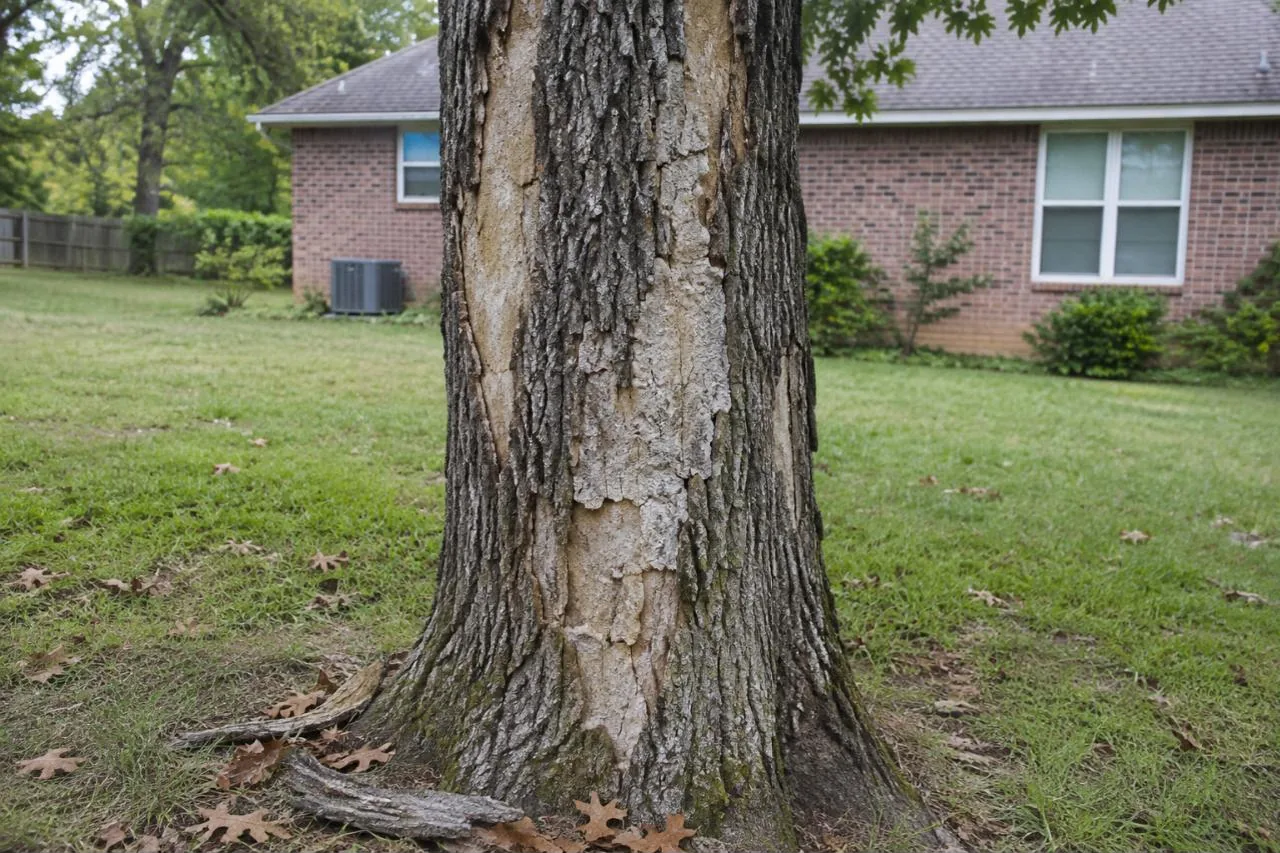
These come from the U of A's publications, roughly in the order they appear:
- Thin or yellow leaves at the top. Yellowing or small leaves, a thinning crown and dead branches in the upper canopy usually come first. Upper limbs often die first and are easy to miss from the ground.
- Sprouts on the trunk. A U of A county agent lists water sprouts on the trunk and big limbs as a sign of stress.
- Bark falling off. Pieces of bark 6 to 18 inches long push off the trunk, often near the base.
- A crust under the bark. Underneath is a powdery or fuzzy mat, tan, olive-green or reddish at first, that turns dark brown to black and then silver-gray, like charcoal.
- Dark lines in the wood. A cut section shows dark lines radiating through decaying sapwood.
- Holes and sawdust. Small holes with fine sawdust point to borers; pupal skins point to carpenterworm.
The U of A's reference desk puts the hard truth plainly: "Once bark begins to fall, you can't stop it," and by the time bark sloughs off, the tree is usually dead or nearly so.
How fast it happens
Faster than most people expect. The plant health clinic says that once the canker girdles the trunk, infected trees turn brown and die "apparently overnight." In 2011, the U of A's horticulturist described a large oak taking about two years: the upper limbs die the first year, and the whole tree the second. Mr. Rushing's "randomly die overnight" in June 2026 is the same story.
What nobody can tell you is how long a dead oak will stand before a limb or the trunk lets go. This site found no official figure for it, so don't plan around one. What the U of A does say is that decay of the sapwood is rapid and that canker diseases can "result in wind breakage."
Water oaks and the other weak-wooded oaks
Not every oak is equally risky over a roof. NC State Extension says water oak "may only live 30 to 50 years," that its wood is weaker than most oaks, that its limbs are "notoriously weak," and that it's at risk of breakage in high winds and winter snow or ice storms. A University of Florida study of trees after hurricanes put water oak in its lowest group for wind resistance and listed it among trees to inspect when they get old.
| Oak | NC State Extension | UF wind rating |
|---|---|---|
| Water oak | Rapid growth; "may only live 30 to 50 years"; limbs "notoriously weak" | Lowest |
| Southern red oak | 60 to 100 feet tall; "susceptible to wind damage" | Lowest |
| Willow oak | Long-lived; "susceptible to wind damage" | Medium-low |
| Post oak | 35 to 50 feet; slow growth; drought resistant | Not rated |
A declining water oak or southern red oak over the house combines both problems: weak wood to begin with, and a disease that weakens it further. More species notes are in the Faulkner County trees guide.
Why a dying oak near the house is dangerous
FSA7557 says removal may become necessary "if structural integrity becomes questionable, especially if the tree poses a threat to structures or people." Wind here tests that regularly. On June 6, 2014 and again on June 25, 2023, NWS Storm Data recorded numerous trees blown down across Conway. In December 2000, the weather service wrote that ice "stressed trees and tree limbs to the point where they fell on houses." On June 25, 2023, in Carlisle, in neighboring Lonoke County, "a large tree fell on a house, causing two direct fatalities and one injury."
Can the oak be saved?
It depends on how far along it is. A drought-stressed oak that hasn't started losing bark may pull through with care:
- Water deeply. Mr. Rushing recommended 1 to 3 inches of water a week for trees during drought (U of A, June 29, 2026), and the plant health clinic advises watering large trees through prolonged drought.
- Protect the roots. About 80 percent of a tree's roots are in the top 18 inches of soil, according to Jon Barry, so avoid digging, compacting or adding fill under the crown.
- Avoid wounds. Spores enter through wounds in the bark.
Once bark is falling off and the crust shows underneath, the U of A's guidance points to removal, not treatment.
Removing a big oak in Conway: the rules
- Robinson Historic District. Removing any tree over 8 inches in diameter needs Historic District Commission approval. Include proof the tree is dead or can't be saved, such as a letter from a landscape firm. The stump must be removed or ground to grade, and the guidelines ask for a replacement of a similar species (checked Nov 10, 2026).
- Old Conway. In the design overlay district, the commission has required trees over 8 inches to be protected during new construction. Call City Hall, 501-450-6100 (checked Nov 10, 2026), before removing one.
- Elsewhere in Conway. This site found no city permit for removing a tree on a private home lot; the tree ordinance covers public trees (checked Nov 10, 2026).
- The debris. Under Ordinance O-77-12, the tree crew hauls away its own debris, and Conway Sanitation won't collect limbs from contracted work. In Greenbrier, the city picks up limbs by appointment, 501.679.3014, but "will not pick up brush or leaves" (checked Nov 10, 2026).
- Wires. Keep people and equipment at least 10 feet from energized overhead lines, as First Electric Cooperative advises under state law. Conway Corporation outages: 501-450-6000 (checked Nov 10, 2026).
- The stump. Call 811 two working days before grinding or digging (checked Nov 10, 2026).
The full details are in the Conway tree rules guide.
What to do with the wood
The plant health clinic advises removing dead and dying trees at ground level, then burning them or hauling them off the property to reduce spore production. Burning is only an option when no county burn ban is in force; Faulkner County's latest ban was lifted at 9 a.m. on November 3, 2026 (checked Nov 10, 2026). If you keep the logs for firewood, the state Forestry Division asks people not to move firewood long distances.
What a big oak costs to remove
Thumbtack's 2026 tree removal guide prices a 24- to 36-inch trunk at $976 to $2,573 with a canopy under 30 feet, and $1,562 to $4,117 with a canopy over 30 feet. Grinding a 24- to 36-inch stump runs $355 to $486 (all checked Nov 10, 2026). Its trimming guide says emergency fees are "sometimes as high as $250 an hour" (checked Nov 10, 2026), which is one more reason not to wait for a storm. These are national numbers, and the contractor's written price is what counts. See what tree work costs.
If a dying oak does fall on the house, the Insurance Information Institute said in 2010 that debris removal coverage generally runs about $500 to $1,000. The Arkansas Insurance Department's Consumer Services line is 501-371-2640 (checked Nov 10, 2026).
Oak questions
Is hypoxylon canker contagious to my other oaks?
The fungus only takes over stressed trees; the clinic says it is "unable to attack and kill healthy trees." Removing the dead tree and hauling or burning the wood reduces spores, and watering the others through drought helps keep them healthy.
My oak leafed out green on one side and bare on the other. What does that mean?
Dieback in part of the crown is one of the early signs the U of A lists. Check the trunk for loose or missing bark and have it looked at before the next storm season.
Can I wait until winter to take it down?
If the bark is already falling off, the U of A says the tree is usually dead or nearly so, and the weakened wood breaks in wind. A dying oak over the house shouldn't wait for a convenient season.
Do I need permission to remove a dead oak in the historic district?
Yes, for any tree over 8 inches across in the Robinson Historic District (checked Nov 10, 2026). Proof that the tree is dead helps the request.
An oak request sent from this site goes to one independent contractor who works in Conway and Faulkner County. The site itself doesn't diagnose or remove trees.
Sources
- NWS Little Rock, January 2026 summary; Storm Data, June 2014; Storm Data, June 2023; December 2000 ice storms.
- U of A Division of Agriculture: drought and timber, June 29, 2026; burn ban awareness, Aug. 20, 2026; FSA7557, Hypoxylon Canker of Hardwood Shade Trees; Plant of the Week, Oct. 14, 2011; Plant Health Clinic Newsletter, May 29, 2018; reference desk, canker; White County, hypoxylon canker; Common Insect Problems.
- Jon Barry, U of A, Receding Drought Leaves Deadly Touch Among Arkansas Trees.
- USDA Forest Service, Arkansas Forest Health Highlights 2025 and 2003. University of Arkansas Arthropod Museum, Red oak borer.
- NC State Extension Plant Toolbox: water oak, southern red oak, willow oak, post oak. University of Florida IFAS, FR173, Wind and Trees. Checked Nov 10, 2026.
- Conway Historic District Commission, Design Guidelines and minutes, May 27, 2026; City of Conway, Ordinance O-11-51, Ordinance O-77-12 and yard waste; City of Greenbrier, Water, Sewer and Street. Checked Nov 10, 2026.
- First Electric Cooperative, working near power lines; Conway Corporation, outages and call before you dig; Faulkner County, burn ban notice; Arkansas Department of Agriculture, Forest Health. Checked Nov 10, 2026.
- Thumbtack, Tree Removal Cost Guide 2026 and 2026 Tree Trimming Cost Guide. Insurance Information Institute, July 22, 2010 release. Arkansas Insurance Department, Contact. Checked Nov 10, 2026.