
Does Conway require a permit?
Conway's tree ordinance, O-06-26, passed in March 2006 and amended by O-11-51 in June 2011, is about public trees. Under the 2011 version, it is unlawful for anyone to "destroy, transplant or remove any Public Tree" without the approval of both the Conway Tree Board and the City Council. The ordinance counts poisoning the roots or grading inside a public tree's drip line as destroying it, and any tree planted on public property becomes city property (checked Nov 10, 2026).
A tree in your own yard isn't a public tree. The city's zoning code also says a single-family house allowed by right in its zone isn't subject to Development Review, the process where Conway's tree preservation and landscaping rules apply. So for an ordinary house lot outside the historic areas, this site found no city permit to remove a tree (checked Nov 10, 2026).
Two situations change that:
- The Robinson Historic District. Conway's historic district design guidelines say "removal of any trees over eight inches (8") in diameter must be approved by the HDC," the Historic District Commission. The request should include photos or a site plan, proof the tree is dead or can't be saved (a letter from a landscape firm is one example the guidelines give), and the species and size of the replacement. The stump has to be removed or ground level with the soil around it (checked Nov 10, 2026).
- Old Conway. In the Old Conway Design Overlay District, which the same commission reviews, it has required trees over 8 inches to be protected as a condition of approving new construction. Whether pulling a tree from an existing lot there needs approval wasn't clear from the city's records, so call Planning and Development at City Hall, 501-450-6100 (checked Nov 10, 2026), before removing a tree over 8 inches.
Trees along streets and alleys are a separate matter. The ordinance lets the city and Conway Corporation prune or remove trees in street and alley rights-of-way and in easements when they're unsafe, damage infrastructure or are infested. If the tree you're worried about stands between the sidewalk and the street, ask the city before anyone cuts it. The Conway tree rules guide covers all of this in more depth.
Greenbrier, Vilonia, Mayflower and county land
Much of Faulkner County lies outside Conway, and each town handles trees its own way:
- Vilonia. The city's permits page lists building, site plan, sign and business permits. This site found no Vilonia permit for removing a tree on a private lot. City Hall: 501-796-2534 (checked Nov 10, 2026).
- Greenbrier. City Hall is at 11 Wilson Farm Road, 501.679.2422 (checked Nov 10, 2026). Ask there about any tree rule before a large removal.
- Mayflower. City Center, 5 Ashmore Drive, (501) 470-1337; the office is closed Fridays (checked Nov 10, 2026).
- Unincorporated county land. Springhill, Pickles Gap, Cato and the county roads answer to Faulkner County. A tree on a county road belongs to the Road Department, 501-450-4930 (checked Nov 10, 2026). Private roads are the responsibility of the owners along them.
- State highways. A tree in an ArDOT right-of-way may need an ArDOT permit; call the District 8 office at (479) 968-2286 and ask for the permit officer first. The Faulkner County maintenance office is at (501) 329-2577 (both checked Nov 10, 2026).
Conway has many subdivisions. If yours has covenants, read them before a removal; some set their own rules for trees.
How a big tree comes down beside a brick house
Picture a tall pine or a spreading oak a few yards from a brick ranch house, with a fence, a shop or the service line somewhere nearby. How a tree like that comes down depends on how much open ground there is:
- Dropped whole. A notch on the side where the tree should go and a back cut opposite. It takes clear ground longer than the tree is tall. NC State Extension puts loblolly pine at 60 to 90 feet and shortleaf at 80 to 100 feet, so on a typical city lot there's rarely room. On acreage near Greenbrier or Guy there may be.
- Taken down in sections. Limbs come off first, cut by a climber in the tree or from a bucket truck, and the trunk follows in short lengths. Anything above the roof, a carport or the fence is tied off and lowered by rope. Water oaks spread 50 to 70 feet wide in NC State's numbers, so a big one often reaches over the house on one side.
- Lifted out by crane. A tree leaning over the house with no safe landing spot may come out in sections lifted by a crane. The crane needs firm, level ground and room clear of overhead lines.
Big equipment has its own cost: Thumbtack's 2026 guide says delivering a large tree lift is "sometimes around $450 alone" (checked Nov 10, 2026). Ask which method the crew will use, where each piece will land, and what will keep the lawn and driveway from being torn up. A good answer is specific.
Pines and oaks come down differently
Pines are tall and narrow; NC State lists loblolly at 20 to 40 feet wide. That makes a pine easier to section than its height suggests, but its top can still reach the roof from far across the yard. Mississippi State University Extension adds a warning that matters in a yard full of pines: soil packed down or rutted over the roots during tree work raises the risk of bark beetle attack on the pines left standing. Keep heavy equipment off the root zones of the trees you're keeping, especially after a drought.
Oaks are wide and heavy. A dead or declining oak needs extra care, too: the U of A says canker diseases like the one killing drought-stressed oaks can "result in wind breakage." If your tree is an oak that browned out this year, start with the dying oak guide.
Who hauls the brush in Conway
This is where Conway differs from many towns. City Ordinance O-77-12, passed in April 1977, makes the tree trimmer or cutter "responsible for removing any limbs, branches or other cutting and/or trimming debris from the job site," and says the Sanitation Department will not take it. The city's current yard waste page still points to that ordinance: professional tree trimming and cutting services must haul away the yard waste they generate, and "brush and limbs generated as a result of contracted work will not be collected curbside" (checked Nov 10, 2026).
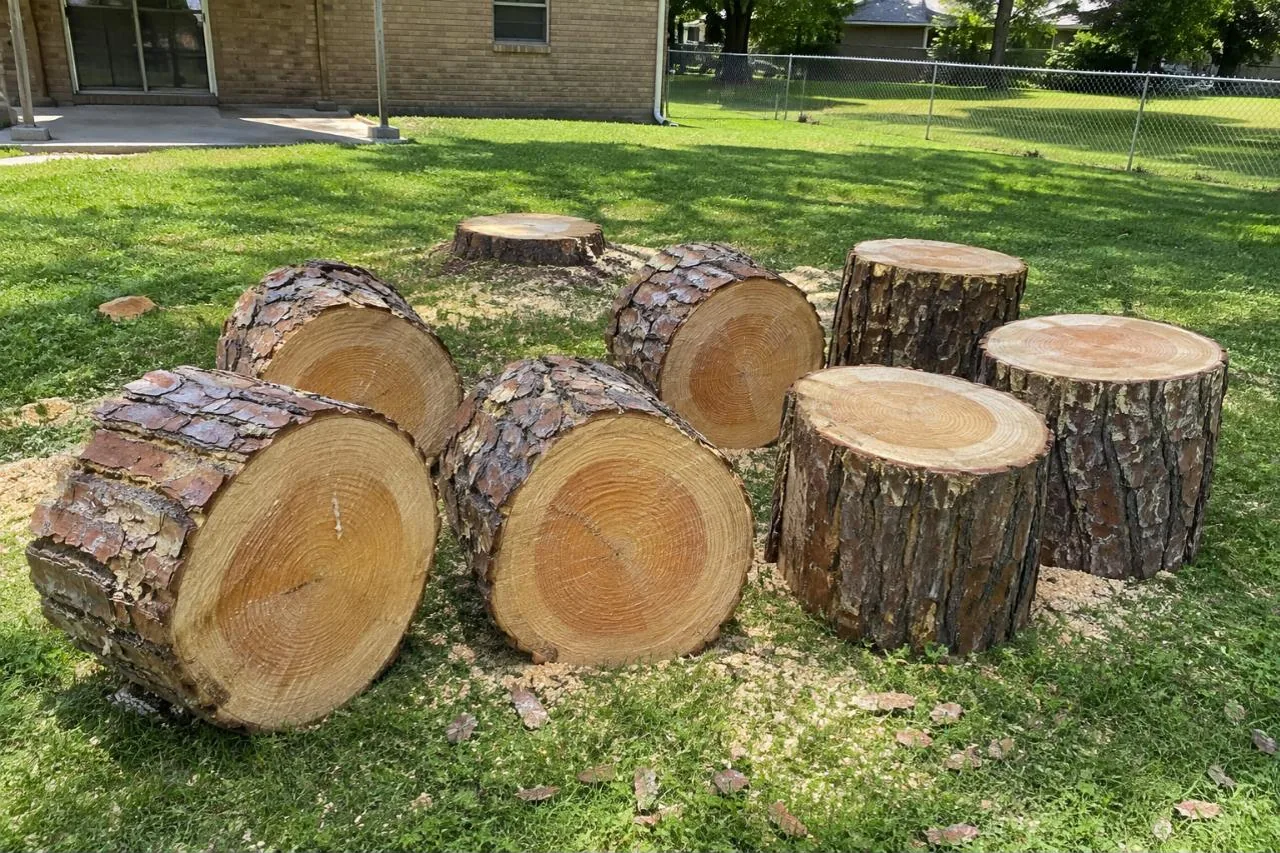
The city's regular curbside yard waste pickup is for homeowners' own yard debris. Brush piles can't be larger than 10 feet long, 10 feet wide and 3 feet high, and the service is "not applicable for tree removal." Trees aren't accepted at bulky item pickup either (checked Nov 10, 2026). So when you hire a tree crew in Conway, the price should say what happens to every piece: chipped and hauled, logs cut to stove length and stacked, or chips left for your beds.
Outside Conway, Greenbrier picks up limbs by appointment (501.679.3014) but says it "will not pick up brush or leaves." Mayflower holds yard waste pickup days; call (501) 470-1337 for the rules (both checked Nov 10, 2026). Burning is covered on the rules page; it's never allowed during a county burn ban.
Wires and the service line
Look at your electric bill to see who serves the house. Conway Corporation supplies the City of Conway, and Entergy Arkansas, Petit Jean Electric Cooperative and First Electric Cooperative serve other parts of Faulkner County. Entergy's tree trimming page says it trims only to keep service reliable and safe, and that it doesn't remove storm debris, debris from trimming a customer asked for, or hazard-tree debris (checked Nov 10, 2026).
First Electric Cooperative, citing Arkansas Code § 11-5-307, says to keep all people, equipment and materials at least 10 feet from energized overhead lines (checked Nov 10, 2026). The statute (2020 code text) requires written notice to the state Division of Labor and to the line's owner before anyone works closer than the law allows. Say in your request if any wire runs through or near the tree; it changes who does which part and when.
The stump
Unless grinding is in the written price, expect the stump to stay. In the Robinson Historic District it can't stay: the guidelines require it removed or ground to grade. Grinding goes into the ground, so call 811 first. Conway Corporation asks for at least two business days' notice through 811 or 1-800-482-8998 before digging (checked Nov 10, 2026). More on stump grinding.
Where removals go wrong
- Cutting first in the historic district. In the Robinson Historic District, a tree over 8 inches comes down only with the commission's approval (checked Nov 10, 2026).
- Brush left at the curb. Conway's Sanitation Department won't collect debris from contracted tree work, so a pile left behind may stay yours to deal with.
- No landing plan. One trunk section dropped on a shingle roof or a fence costs more than the extra rigging would have.
- Ruts over the roots. Packing the soil over the roots of the pines you're keeping can invite bark beetles, per Mississippi State Extension.
- Burning on a ban day. Faulkner County was under a burn ban from August 13 to November 3, 2026, and ordered others in January and March (checked Nov 10, 2026).
Published removal prices
Thumbtack's tree removal guide, last revised March 24, 2026, says felling and removing one tree averages $450 to $1,450 nationally when the stump stays, and $884 to $1,627 when it goes (checked Nov 10, 2026). Sorted by size, the cheapest cell, a trunk thinner than a foot under a crown narrower than 30 feet, is $226 to $596; the priciest, a two- to three-foot trunk under a crown wider than 30 feet, is $1,562 to $4,117. These aren't Faulkner County prices. The contractor's written figure for your tree is what counts. The full tables are on what tree work costs.
When removal isn't the right page
A healthy oak that only hangs over the roof may need a trim instead. A tree that's already down after a storm belongs under storm and emergency removal. A pine turning red or a tree that has started to lean is covered in dead or leaning trees.
Removal questions
Can the city cut down the tree by the street for me?
The ordinance lets the city and Conway Corporation prune or remove right-of-way trees that are unsafe, damage infrastructure or are infested. For a tree on your side of the property line, the work and the cost are yours. Call City Hall at 501-450-6100 (checked Nov 10, 2026) if you aren't sure where the line is.
Do I need permission to take down a dead tree in the Robinson Historic District?
Yes, if it's over 8 inches across. The guidelines ask for proof the tree is dead or can't be saved, such as a letter from a landscape firm, and a replacement of a similar species (checked Nov 10, 2026).
Can I keep the wood?
Usually. Have the trunk cut to firewood length and stacked where you want it. Less hauling can lower the price. Arkansas's Forestry Division asks people not to move firewood long distances, so burn it close to home.
Can I put the limbs out with my yard waste?
Not if a hired crew cut them. Conway says brush and limbs from contracted work won't be collected curbside (checked Nov 10, 2026).
Send a removal request here and one independent contractor who works around Conway receives it. The site itself doesn't remove trees.
Sources
- City of Conway, Ordinance O-06-26 and Ordinance O-11-51 (tree ordinance). Checked Nov 10, 2026.
- City of Conway, Zoning Code, Sec. 1101. Checked Nov 10, 2026.
- Conway Historic District Commission, Design Guidelines; HDC minutes, May 27, 2026. Checked Nov 10, 2026.
- City of Conway, Ordinance O-77-12 (1977) and Sanitation yard waste page. Checked Nov 10, 2026.
- City of Vilonia, Permits; City of Greenbrier, Water, Sewer and Street; City of Mayflower, Yard Waste Pickup; Faulkner County, Road Department; ArDOT, District 8. Checked Nov 10, 2026.
- NC State Extension Plant Toolbox: loblolly pine, shortleaf pine, water oak. Checked Nov 10, 2026.
- Mississippi State University Extension, Bark Beetles in Urban Pines. U of A Division of Agriculture, FSA7557, Hypoxylon Canker of Hardwood Shade Trees. Arkansas Department of Agriculture, Forest Health.
- Entergy, Tree trimming; First Electric Cooperative, Working near power lines; Conway Corporation, call before you dig. Checked Nov 10, 2026.
- Faulkner County, news and burn ban orders. Checked Nov 10, 2026.
- Thumbtack, Tree Removal Cost Guide 2026, updated March 24, 2026. Checked Nov 10, 2026.