
Call Arkansas 811 first
A stump grinder chews below the surface, and gas, water, sewer, electric and cable lines can run almost anywhere in a yard. Arkansas One Call, the state's 811 center, happens to be headquartered in Conway, at 2120 Maple Ridge Circle. It takes requests around the clock (checked Nov 10, 2026).
- When to call. The Common Ground Alliance's Arkansas page lists two working days' notice before digging. State law, Ark. Code § 14-271-112, says at least two but not more than ten full working days before excavation starts (2014 code text).
- How long the marks last. Marks are good for 20 working days if work starts within 10 working days of the ticket (checked Nov 10, 2026).
- The tolerance zone. Arkansas's tolerance zone around a marked line is 18 inches (checked Nov 10, 2026).
- Conway Corporation's numbers. Conway Corp asks residents to call 811 or 1-800-482-8998 at least two business days before digging, and marks electric lines in red, water in blue, sewer in green and cable in orange (checked Nov 10, 2026).
Whether a particular grinding job legally counts as excavation isn't spelled out on the pages this site read, so the safe rule is simple: call 811 before stump grinding or any digging near utility lines. Also point out any lines you ran yourself, like power to a detached shop or a sprinkler line, so the crew knows where they are.
Stumps in the Robinson Historic District
Conway's historic district design guidelines say that if a tree is removed, "the stump must be removed or ground to the surrounding surface soil level." The same guidelines ask that damaged or diseased trees be replaced with a similar species, in the same spot or nearby (checked Nov 10, 2026). If the replacement is going where the old tree stood, the grinding has to clear enough room for the new root ball. Removing a tree over 8 inches in the district needs Historic District Commission approval first; see the Conway tree rules.
Rock, clay and wet flats
Faulkner County sits where the Ozarks meet the Arkansas River Valley, and the region's soils range from rocky hillsides to silty flats. USDA's official soil series descriptions for the region show the pattern (this site didn't confirm which series lie under any particular Conway street):
| Setting | Example soil series | What's underneath |
|---|---|---|
| Hill backslopes | Mountainburg | Sandstone at 12 to 20 inches; a very cobbly subsoil, 35 to 60 percent rock fragments |
| Hill and ridge tops | Linker | Yellowish-red loam over sandstone at 20 to 40 inches |
| Ridges over shale | Enders | Yellowish-red to red silty clay or clay that water moves through very slowly, over shale at about 4 feet |
| Upland flats and terraces | Taft, Guthrie | Silty soil over a dense layer (fragipan) at about 20 to 36 inches; some areas pond in winter and spring |
What that means for a stump: on upland lots, the grinder may hit sandstone pieces around and under the roots, which slows the work and is hard on the machine's teeth. On clay or a wet flat, a heavy machine can rut the lawn after rain. Mention it in your request if you know your yard is rocky or stays wet.
How the grinding goes
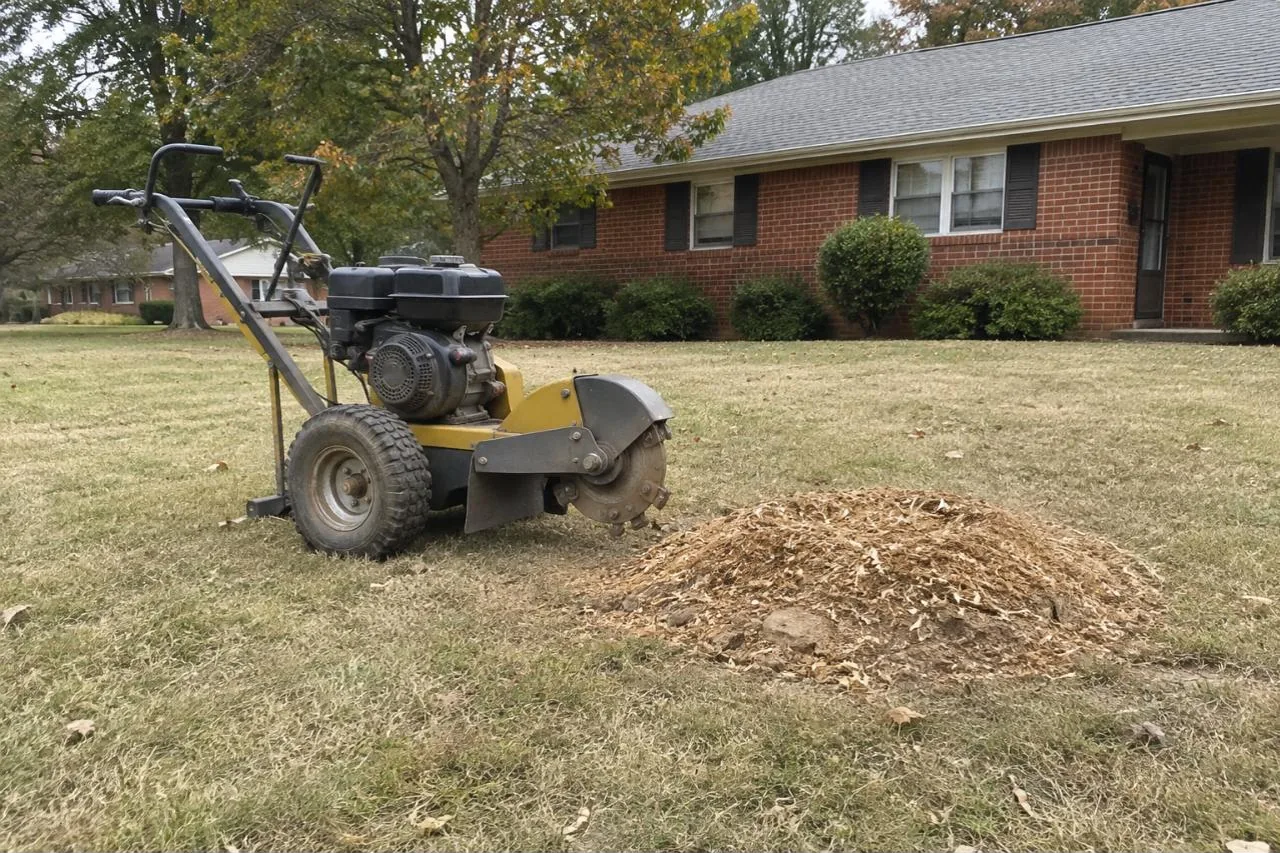
A stump grinder is a spinning wheel with carbide teeth that sweeps back and forth across the stump, turning wood into chips. Small walk-behind machines fit through a typical backyard gate; larger self-propelled or towed machines work faster but need a wide, firm path. Measure your gate before the visit.
The grinder doesn't stop at the bark line. Surface roots running out from the stump can be ground too, and each one you want gone should be pointed out and written into the job. If those roots run toward a tree you're keeping, be careful: Extension forester Jon Barry of the University of Arkansas notes that about 80 percent of a tree's roots sit in the top 18 inches of soil.
The chips and the hole
Grinding a big stump leaves a mound of chips mixed with soil, like the one in the photo above. Decide what happens to it before the work starts:
- Use it as mulch. The Arkansas Division of Environmental Quality lists mulching, chipping and composting among the alternatives to burning yard waste.
- Have it hauled. Conway's 1977 ordinance makes tree trimmers and cutters haul away the debris from their work, and the city says it won't collect brush and limbs from contracted work at the curb (checked Nov 10, 2026). The ordinance is written around limbs and branches, so get the chips in writing too.
- Fill and seed. Chips settle and break down over time. Raking most of them out, filling the hole with topsoil and seeding it gets grass back sooner.
Stumps from diseased oaks and beetle-killed pines
If the tree died of hypoxylon canker, the U of A's plant health clinic advises removing dead and dying trees at ground level and then burning the wood or hauling it off the property to cut down on spore production. That makes a low cut and prompt grinding sensible for a drought-killed oak.
For pines killed by Ips engraver beetles, the U of A Extension's forestry page says to remove infested trees promptly and use or destroy them, including the bark and debris. More on both problems in dead or leaning trees and the dying oak guide.
What stump grinding costs
Thumbtack's tree removal guide, updated March 24, 2026, prices stump grinding alone by stump diameter (checked Nov 10, 2026):
| How wide the stump is | Low end | High end |
|---|---|---|
| Up to 12 inches wide | $267 | $354 |
| 12 to 24 inches wide | $324 | $443 |
| 24 to 36 inches wide | $355 | $486 |
| 36 to 48 inches wide | $372 | $494 |
Thumbtack's overall figure for grinding is about $307 to $426. When the stump is handled with the tree, its guide puts cutting down a tree plus stump removal at $884 to $1,627 on average (both checked Nov 10, 2026). These are national prices. Rock, a tight gate, several stumps, long surface roots and hauling the chips all change a Conway price, and the contractor's written figure is the one to go by. All the price tables are on what tree work costs.
When leaving the stump is fine
Outside the Robinson Historic District, nothing this site found requires grinding a stump on a private lot. A low stump at the back of a wooded lot can simply be left. Grinding makes sense where you mow, where you plan to replant or build, or where the stump is a trip hazard. If the tree came down because of a disease, see the section above.
Stump questions
The oak died of hypoxylon canker. Should the stump go?
The U of A's plant health clinic advises cutting dead and dying trees at ground level and burning the wood or hauling it away, to cut down on the fungus's spores. A low cut followed by grinding fits that advice.
Will Conway pick up the chips?
Not from a hired crew's work. Conway's yard waste service is for residents' own yard debris, and debris from contracted tree work is the contractor's to haul (checked Nov 10, 2026).
Can a stump be ground behind a fence?
Usually, with a small walk-behind grinder. Measure the gate and mention it in your request.
Can I plant a new tree in the same spot?
Yes, once the chips are cleared and the hole is filled with soil. In the Robinson Historic District, the guidelines ask for a replacement of a similar species in the same spot or nearby.
A stump grinding request sent from this site goes to one independent contractor who works around Conway. The site itself owns no grinder.
Sources
- Common Ground Alliance, Arkansas state page (Arkansas One Call). Checked Nov 10, 2026.
- Conway Corporation, call before you dig. Checked Nov 10, 2026.
- Arkansas Code § 14-271-112 (2014 text, via Justia).
- Conway Historic District Commission, Design Guidelines. Checked Nov 10, 2026.
- USDA official soil series descriptions: Mountainburg, Linker, Enders, Taft, Guthrie. Checked Nov 10, 2026.
- Jon Barry, U of A, Receding Drought Leaves Deadly Touch Among Arkansas Trees.
- Arkansas Division of Environmental Quality, Open Burning (July 2020).
- City of Conway, Ordinance O-77-12 and yard waste. Checked Nov 10, 2026.
- U of A Division of Agriculture, Plant Health Clinic Newsletter, May 29, 2018; Common Insect Problems (checked Nov 10, 2026).
- Thumbtack, Tree Removal Cost Guide 2026, updated March 24, 2026. Checked Nov 10, 2026.